Mental Model · Analysis & Framing · Innovation & Design
Complex Adaptive Systems
Many interacting agents following simple rules create emergent behaviour.
After Complexity science (John Holland, Murray Gell-Mann, Stuart Kauffman, Melanie Mitchell; Santa Fe Institute)
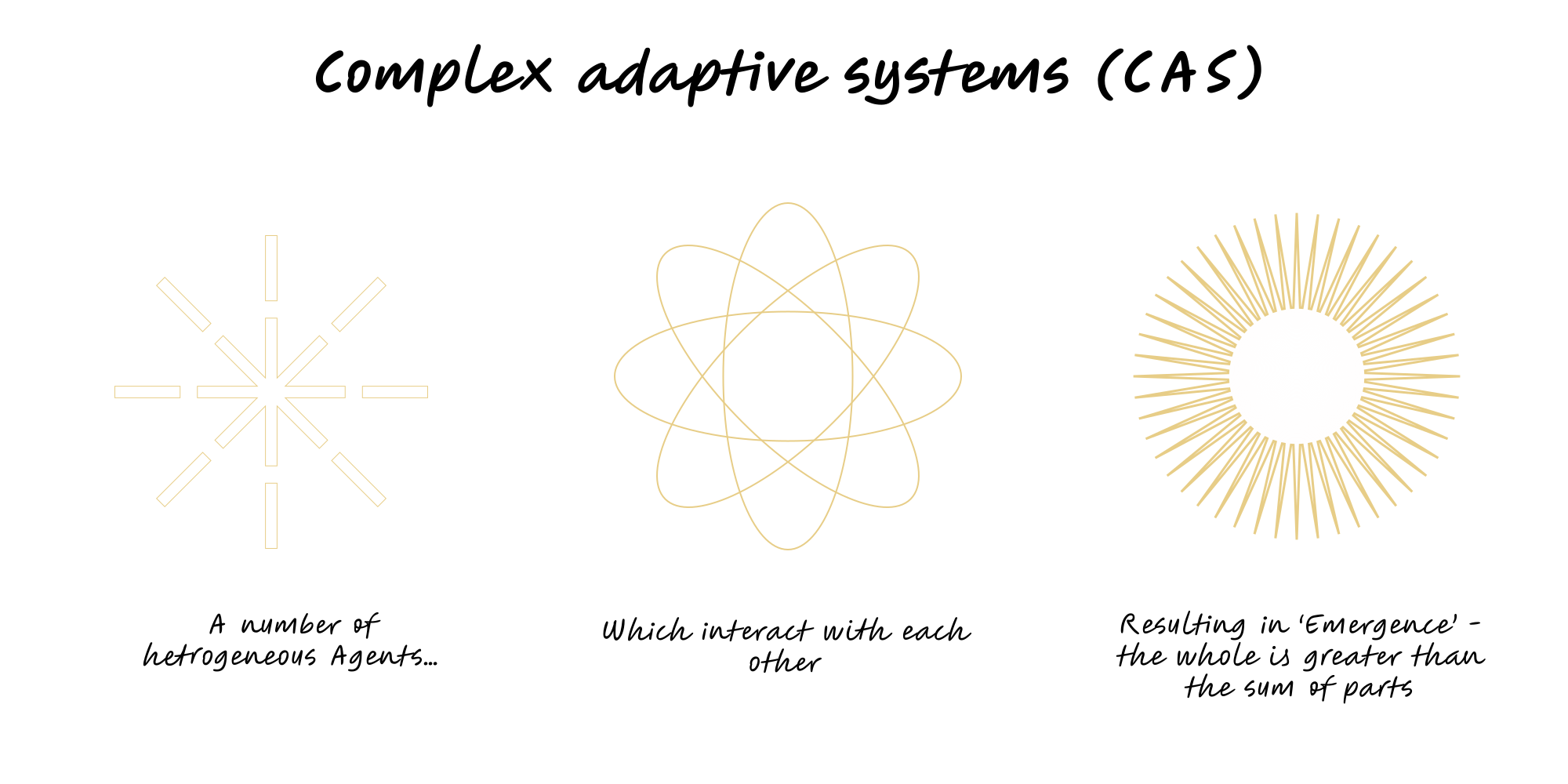
A complex adaptive system (CAS) is made of many agents (people, teams, firms, microbes, services) that learn and adapt as they interact. Because interactions are non-linear and full of feedback, the whole system shows patterns you can’t predict by inspecting parts alone (emergence). The practical move is to design conditions — rules, incentives, network links, guardrails — so desirable patterns are more likely to appear and persist.
How it works
Agents & local rules – each actor follows simple rules and incentives; global patterns emerge from many local decisions.
Interaction topology – who connects to whom matters (hubs, clusters, weak ties); topology shapes diffusion and failure.
Feedback loops – reinforcing (growth) and balancing (stability) loops, often with delays.
Non-linearity & thresholds – small nudges can trigger big shifts once a tipping point is crossed.
Adaptation & co-evolution – agents change in response to others; today’s solution alters tomorrow’s game.
Path dependence – early accidents and lock-in steer future options; history matters.
Diversity & requisite variety – heterogeneous agents handle a wider range of shocks; monocultures fail together.
Robust-yet-fragile – systems can be resilient to common shocks yet brittle to rare ones; design for both.
Use-cases
Product ecosystems & marketplaces – seed both sides, tune incentives, prevent spam/abuse cascades.
Organisations – teams as agents; culture and incentives as rules; collaboration networks as topology.
Supply chains & operations – buffers, dual sourcing, decoupling to prevent cascades.
Epidemics & virality – model spread, thresholds and targeted interventions.
Financial & risk systems – leverage, liquidity and network exposure create non-linear crises.
Policy & urban planning – small local rules (zoning, pricing) produce city-scale patterns.
Step-by-step
-
Define boundary & purpose – what’s in scope, and what “good” looks like (fitness function).
-
Map agents, incentives, and links – who acts, why they act, and how they connect (hubs, clusters, bridges).
-
Surface feedback & delays – list reinforcing/balancing loops; note lags that cause oscillations.
-
Design simple rules – defaults, constraints and incentives that make good behaviours easy and bad ones costly.
-
Run safe-to-fail probes – small, parallel experiments; keep what works, kill what doesn’t.
-
Rewire topology where needed – add/remove links (e.g., routing rules, moderation, team interfaces) to change diffusion and risk.
-
Add modularity & buffers – isolate components, add slack at bottlenecks, use circuit-breakers for surges.
-
Monitor early warnings – rising variance, autocorrelation, queue lengths, near-miss rates; watch tail risks, not just averages.
-
Iterate on a cadence – short observe–decide–act loops; expect the system to change in response to your changes.
Pitfalls & Cautions
Command-and-control bias – micro-managing agents instead of shaping rules and incentives.
Linear planning – straight-line forecasts in a non-linear regime.
Optimising a part – local KPIs that damage whole-system performance (suboptimisation).
Monoculture – uniform processes/tech that increase correlated failure.
Over-fitting one model – treat models as lenses; use multiple and compare.
Ignoring time scales – fast and slow loops collide (daily targets vs quarterly replenishment) and create whiplash.