Mental Model · Behaviour & Cognitive Bias · Communication & Influence
Cognitive Bias
Systematic shortcuts in thinking that create predictable errors. Know the patterns; design decisions and communication to counter their effects.
After Behavioural economics and cognitive psychology (notably Daniel Kahneman & Amos Tversky)
Cognitive biases arise because the brain uses heuristics to act fast under uncertainty. These shortcuts are efficient, but they tilt judgement in consistent ways — especially with noisy data, incentives, and time pressure. The goal isn’t to eliminate bias (impossible) but to shape processes so important decisions are less error-prone.
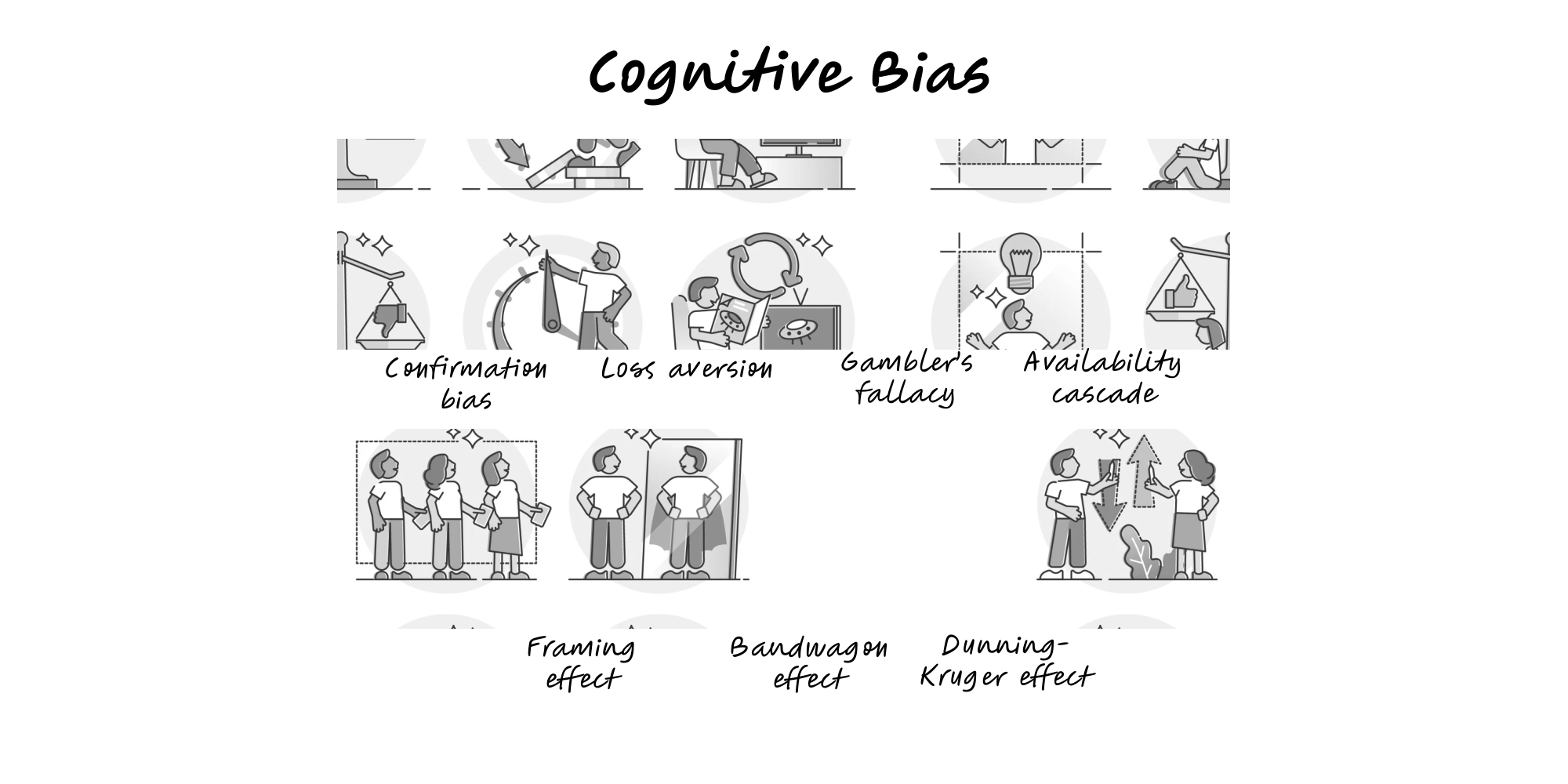
How it works
Speed vs accuracy – fast, intuitive processing (often “System 1”) trades rigour for speed; slow, analytical processing (“System 2”) corrects when engaged.
Common families (with examples)
-
Confirmation bias – we search for and overweight evidence that supports our prior.
Countermoves: pre-register disconfirming tests; assign a “red team”; force a “what would change our mind?” line.
-
Loss aversion – losses loom larger than equivalent gains (often ~2×).
Countermoves: show both frames (gain and loss); use long-horizon metrics; make reversible trials the default.
-
Gambler’s fallacy – believing independent events self-correct (“after five tails, heads is due”).
Countermoves: state independence/base rates explicitly; display binomial ranges; ban “due for” language in reviews.
-
Availability cascade – repeated, vivid claims feel truer and spread via social proof, regardless of evidence.
Countermoves: require source quality and independent confirmation; add a cool-off for viral topics; track what’s known vs said.
-
Framing effect – choices swing when the same facts are presented differently (e.g., 90% survival vs 10% mortality).
Countermoves: standardise wording; show both frames and absolute numbers with denominators; pre-set decision rules.
-
Bandwagon effects (herding) – people adopt beliefs or actions because others have, not because of private evidence.
Countermoves: collect independent estimates before discussion; use silent votes/Delphi; expose dissent and its evidence.
-
Dunning–Kruger effect – novices overestimate ability; experts may under-estimate variance and assume shared context.
Countermoves: calibration training (forecasting with feedback), checklists and peer review; compare to reference-class outcomes.
Context matters – stress, ambiguity, and incentives amplify bias; check the environment, not just the person.
Use-cases
Decision reviews for strategy, hiring, investment, pricing, and vendor selection.
Research & experiments – survey design, A/B test interpretation, sampling and power.
Risk & forecasting – reference-class baselines, ranges not points, premortems.
Communication – neutral wording, show both frames, order-effects control.
Ops & safety – checklists, standard work, second-checker on high-risk steps.
Step-by-step
How to avoid
-
Define the decision & base rate – write the objective, options, criteria and a reference-class outcome.
-
Get independent estimates first – collect forecasts or scores before any discussion (prevents anchoring/herding).
-
Premortem – “It failed in 12 months — why?” Turn the top causes into mitigations or tests.
-
Consider the opposite – assign a red team and a “what would change our mind?” line.
-
Frame both ways – show gain/loss frames and absolute numbers with denominators; keep wording standard.
-
Check sampling – size, selection, survivorship, time window; prefer cohorts and hold-outs.
-
Pre-commit rules – thresholds, stop/scale criteria, decision windows; avoid ad-hoc pivots.
-
Run reversible tests – small trials beat argument; use expected value, not stories.
-
Calibrate – record probability ranges, track forecast accuracy, and retrain on misses.
-
Align incentives – metrics and pay should reward truth-seeking, not outcome theatre.
Bias-specific guardrails
- Confirmation bias: pre-register disconfirming tests; adversarial collaboration; ban HARKing.
- Loss aversion: use EV and break-even math; emphasise reversibility; evaluate over a longer horizon.
- Gambler’s fallacy: state independence/base rates; show binomial ranges or control charts.
- Availability cascade: require source quality and independent corroboration; add cool-off before big decisions.
- Framing effect: display both frames side-by-side; randomise presentation order.
- Bandwagon effects: silent votes/Delphi; capture minority reports and reasons.
- Dunning–Kruger: use checklists and supervision for novices; peer review; calibration training with feedback.
Pitfalls & Cautions
Checklist theatre – rituals without teeth; tie each step to a real go/no-go or redesign.
Bias labelling as argument – calling someone “biased” doesn’t resolve evidence; show the data and process defect.
Over-correction – slowing everything to a crawl; reserve heavy controls for material decisions.
One-and-done – biases reappear; keep a cadence of calibration and post-mortems.